03 · Looking
Turner's Sketchbooks
Three hundred books of private looking, held at the Tate: the largest single record of how one artist trained his eye on the world.
 03.1
03.1What the Books Are
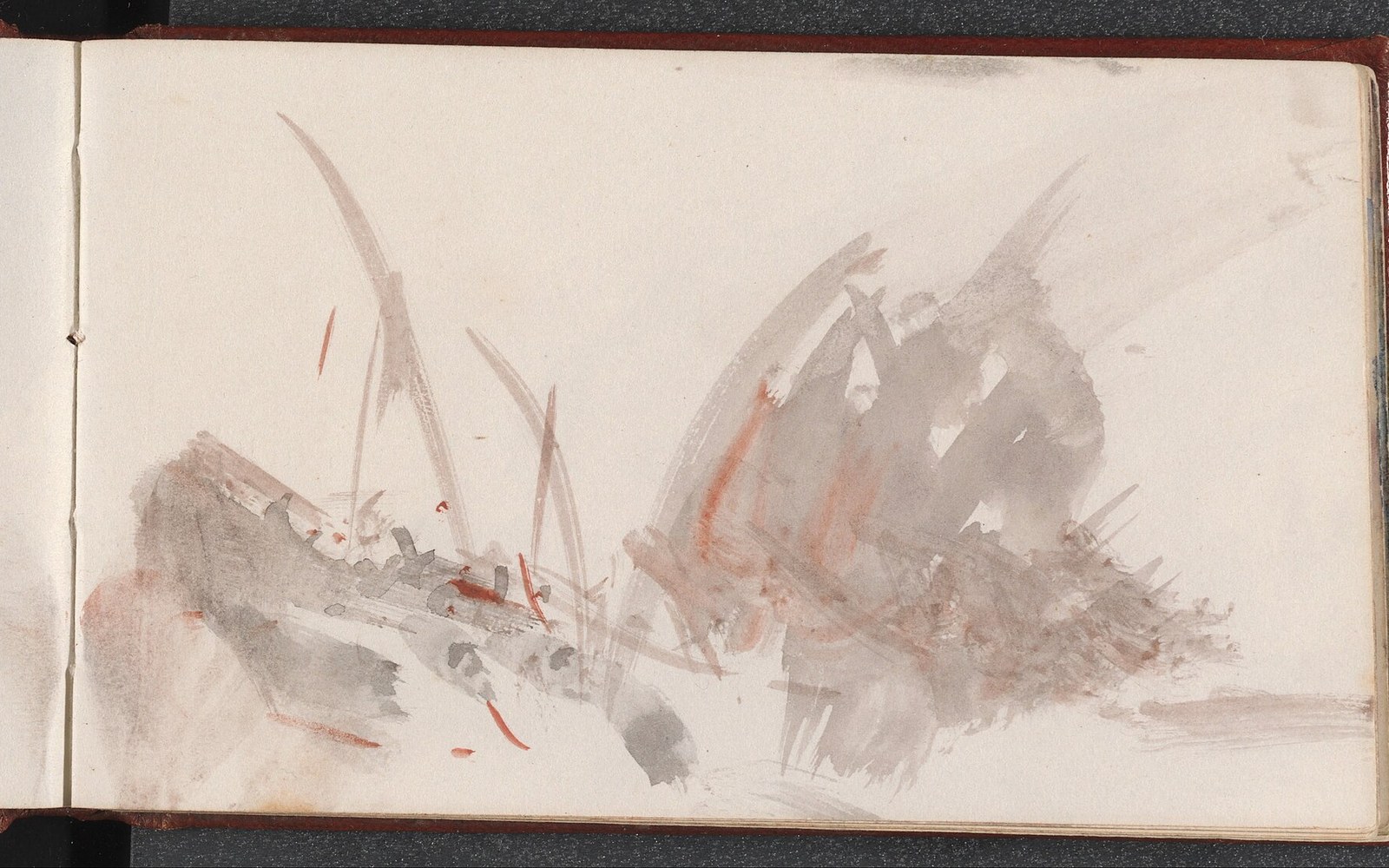
J. M. W. Turner kept sketchbooks from roughly his teenage years until the final decade of his life, accumulating what is now around three hundred volumes, held in the Turner Bequest at Tate Britain. They range from pocket-sized books he carried in a coat to larger landscape-format volumes used in the studio. Many are sewn signatures; some are single gatherings; a few show evidence of rebinding after his death, which scrambled their original page order. Taken together, they form the largest surviving record of one artist's sustained, systematic looking — not a collection of finished work, but the raw material of attention.
The books entered public ownership only because Turner hoarded them. He was famously reluctant to sell drawings, kept thousands back, and at his death in 1851 left the contents of his studio to the nation. A prolonged legal dispute meant the sketchbooks did not formally reach the National Gallery until 1856, and were not transferred to the Tate Gallery until the twentieth century. The full story of that transfer belongs to a separate chapter of institutional history, but the consequence is straightforward: every book is in one place, in broadly known condition, and increasingly accessible via Tate's online catalogue, where pages are photographed recto and verso with consistent reference numbers.
What the books contain
- 01Around 300 volumes — the exact figure varies slightly by catalogue convention
- 02Held in the Turner Bequest, Tate Britain
- 03Transferred from National Gallery to Tate in the twentieth century; formally received by the nation after legal proceedings following Turner's death in 1851
- 04Navigable online via Tate's catalogue, with recto and verso images and consistent reference numbers
How He Worked Them
The mark of Turner's books is economy. Working in pencil on paper that is often slightly warm in tone — cream, buff, occasionally grey — he built a shorthand that lets a few strokes carry enormous information. A hillside becomes three or four horizontal pressures of the pencil; a harbour wall is a single continuous line with a notation — depth, distance, the name of a vessel — written above it in his cramped hand. The annotation is not supplementary; it is structural. Where the eye outran the hand, the word completes the record. Colour notes occur throughout: a sky described as "lemony" above a barely-indicated Venice, a cliff face glossed with a single pigment name.
This is toned paper used at its most functional: the warm ground means the mid-tone does not need filling, only the lights and darks do, and Turner often exploited exactly this, leaving the mid-tone as the page itself and driving a pencil only into the darks and the articulated edges. In the later books, where watercolour appears, it arrives in small, rapid decisions — a patch of blue, a wash across an opening sky — not as a second medium but as an extension of the same fast notation. Measuring by eye, sighting proportions with a stretched hand or against the book's own edge, left traces in the drawings themselves: faint vertical and horizontal guides, a pencil tick at a significant horizon.
The annotations go beyond colour. Turner noted times of day, tidal states, compass bearings and — in the books from his Italian journeys of 1819 and 1828 — proper names: piazzas, bridges, the names that would later anchor a painting. Some of the writing is almost illegible, clearly intended for his own decipherment rather than any reader, which makes the books feel genuinely private in a way that most artists' notebooks do not. He was not making a document for posterity; he was building a retrieval system for himself.
What They Tell Us About Looking
The books are evidence of a practice, not a style. What survives in them is the discipline of selection — the choice, made in the moment, about which edge mattered, which mass needed recording and which could be left as sky. Because Turner returned to material from his sketchbooks for decades — the Venetian notebooks of 1819 fed paintings well into the 1840s — the books also show how memory and drawing collaborate. A notation sharp enough to anchor a composition twenty years later is a very different thing from a holiday record. The question those books implicitly ask is: what is the minimum a drawing needs to carry in order to remain useful?
How the page works
- 01Pencil on cream, buff or occasionally grey paper — the ground acts as mid-tone, never needing to be filled
- 02Annotations record: colour names, times of day, tidal states, compass bearings, place names
- 03Watercolour in later books used as rapid notation, not a separate medium
- 04Sighting marks (faint guides, horizon ticks) visible in many pages
The answer differs across the books. In the Rhine journey of 1817, speed was everything; the drawings are almost calligraphic, a river and its castles rendered in minutes from a moving boat. In the Swiss and Italian books, time was available and Turner used it — a single page might carry two or three studies of the same building from slightly different positions, a practice that is less about composition than about understanding a structure in three dimensions. This is drawing as cognition, not illustration.
Where the books depart from what a camera would have recorded is in their explicit decision-making. Every sketchbook page encodes the choice to look at this and not that; the white space around a rapid study is not emptiness but a record of what was excluded. The notebooks also preserve the sequence of attention — which elements were laid in first, what was corrected, where the pencil lifted and returned. That sequence is itself information about how Turner understood a scene: foreground first in some books, sky first in others, the horizon as an anchor in the river drawings, the mass of a building leading in the city studies.
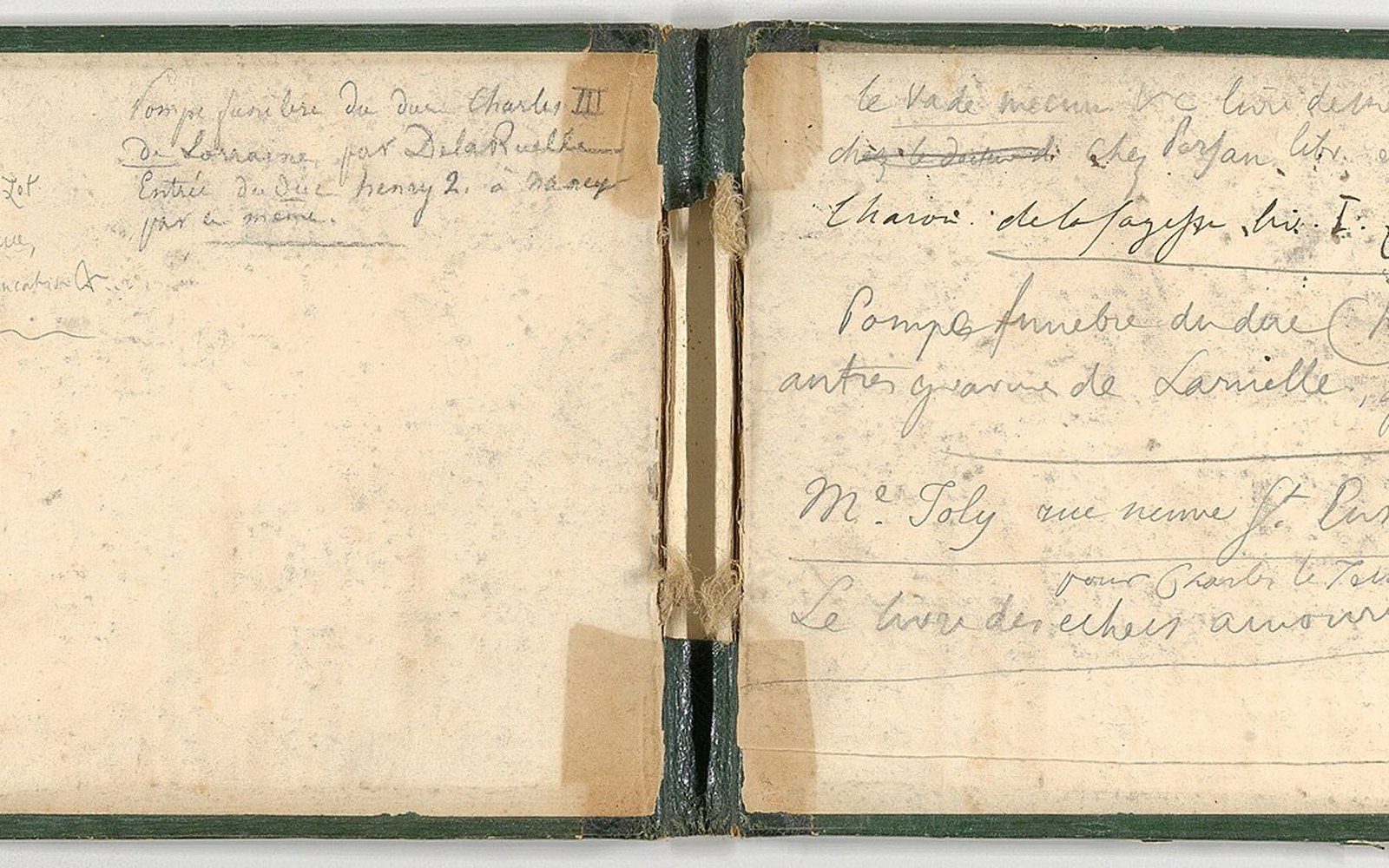
Access to the originals is governed by Tate's conservation requirements — the books are fragile and the paper in some volumes is acidic — but Tate's online viewer makes the complete sequence of most books navigable with reference numbers standardised across the catalogue. Reading a notebook in this way, in page order, rather than cherry-picking the most finished drawings, is the only way to understand the practice rather than the product. The gaps matter as much as the drawings: a sequence of blank pages in a journey book usually marks bad weather or a long interior passage, real events registered by their absence.
What makes Turner's books distinctive within the history of the sketchbook is not their number or their period coverage, though both are remarkable. It is the evidence they provide of systematic, professional looking applied over a long working life — the same habits of annotation, the same economy of mark, the same strategic use of the page ground, recognisable from a book made in his early twenties to the loose-leaf studies of his final years. The books do not show a style developing and settling; they show a method working, consistently, across half a century of looking.