06 · The Page
Composing fast
You choose the frame before you know how it ends, which is why so many location drawings run off the edge.
 06.1
06.1The frame you choose before the scene is finished
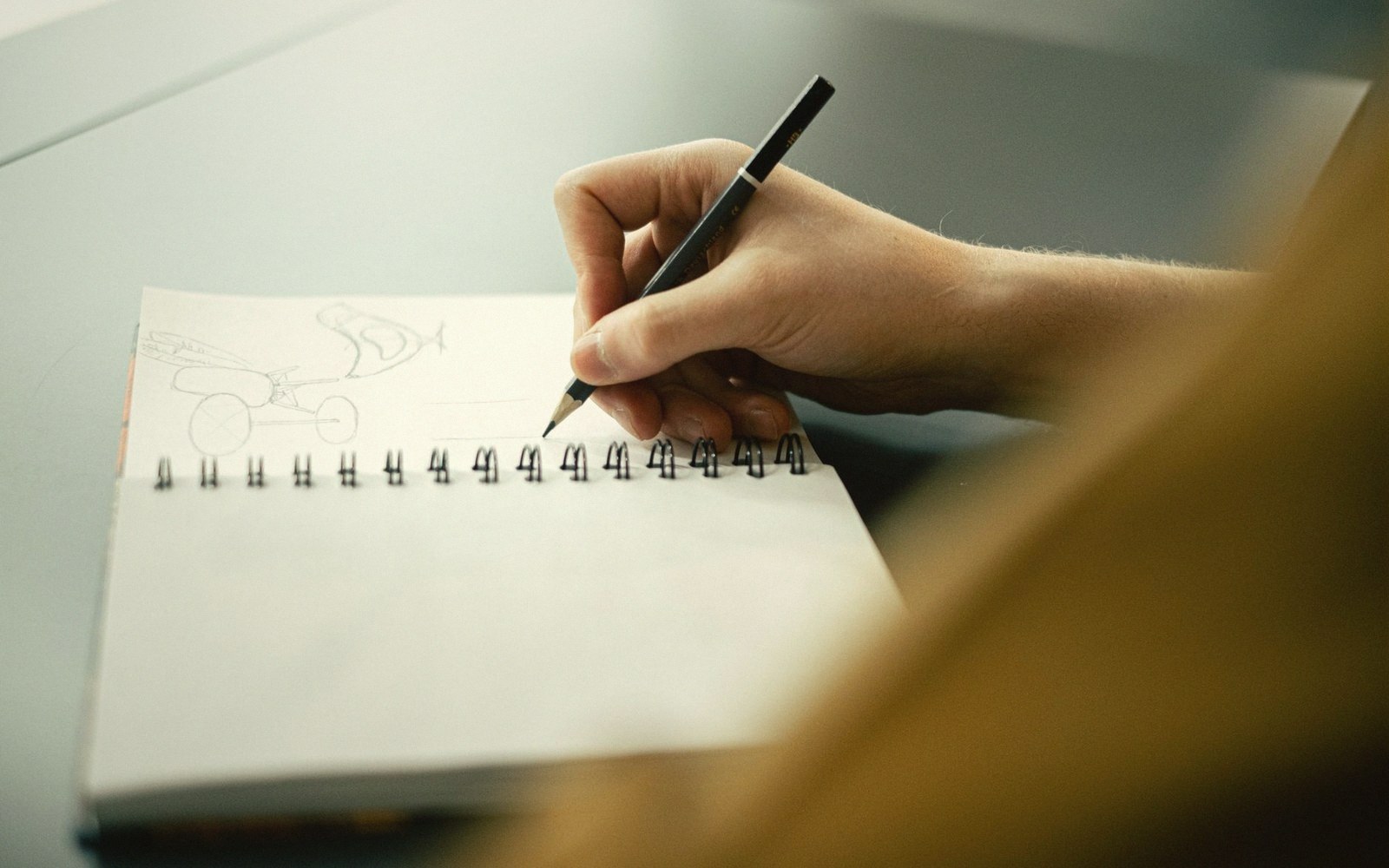
Every compositional decision made on location is a bet. You choose the frame before you know how the scene will end — which corner of the building finishes highest, whether the crane swings left or right, where the crowd thins. The result is that so many location drawings run off the edge of the page, and this is not embarrassing. It is evidence of working at the speed of the world.
A drawing begun in a studio starts from the whole. The painter knows the final canvas, arranges the composition in advance, shifts elements at will. On location, you commit to a rectangle — the spread of a sketchbook, the single page, the postcard-sized leaf — and then the world keeps moving inside it. The frame is a hypothesis.
The method in short
- 01Frame first, weight second — place the compositional anchor early, before proportion is fully resolved
- 02Conservative framing — allow extra room on the side toward which action or depth is moving
- 03Running off the edge — records honest working speed, not compositional failure
- 04Adapt rather than abandon — adjust with line extension, counter-weights or tone when the initial frame proves wrong
Starting with the weight
Experienced location artists tend to place the compositional weight first, before proportion, before tone. The mark that anchors everything — the roofline against sky, the figure in the doorway, the dark arcade — goes down early, roughly right, and becomes the fixed point that everything else is measured against. This is not a formula; it is economy. If time runs short, which it usually does, the anchor is already in. What surrounds it may be incomplete, but the drawing still holds.
Eugène Delacroix did this instinctively in the small notebooks he filled in Morocco in 1832, now held by the Louvre and the Bibliothèque de l'Institut de France. His pages often carry one dense, committed passage and a surrounding looseness — the souk wall rendered with conviction, the distant figures barely touched. The weight is placed, the eye is guided, and the empty edge becomes intention rather than failure.
Turner worked differently, beginning sometimes with the sky — particularly his pencil work on toned paper across the Venice sketchbooks, held in the Turner Bequest at Tate — but the principle is the same: one element is established first that pulls everything else into orbit.
The edge as a decision
Running off the edge happens when the chosen frame turns out to have been wrong, or when the artist was more honest about time than about tidiness. Ronald Searle's wartime drawings from Changi — smuggled out of the camp and now held partly at the Imperial War Museum — sometimes cut figures at the margin in ways that feel modern and intentional, though they were simply made fast under conditions that permitted nothing else. The compression reads as compositional confidence.
Works and collections mentioned
- 01Delacroix Morocco notebooks (1832) — Louvre and Bibliothèque de l'Institut de France
- 02Turner Venice sketchbooks — Tate (Turner Bequest)
- 03Ronald Searle, Changi drawings — Imperial War Museum, London
- 04David Gentleman working notebooks — referenced for in-page adjustment practice
This is worth understanding for what it teaches about cropping. A drawing that shows three-quarters of a market stall, ending abruptly where the paper ran out, forces the viewer's imagination to complete the rest. A photograph has no such edge — it shows everything inside the lens equally. The location drawing, by contrast, shows what the eye was pointed at, and the margin shows where the attention stopped. That is not a deficiency. It is what the camera misses.
The practical consequence is that a good frame choice leans slightly conservative: leave more room than you think you need on the side toward which the action is moving, and compress the space behind. Urban Sketchers, the global network founded by Gabriel Campanario in Seattle in 2007, has produced enough collected work for this tendency to be visible across thousands of published pages — the active corner overflows, the quiet corner breathes.
Adjusting without erasing
When the frame guess is wrong, the response is not to start again but to adapt. Lines can be continued past the ruled border if the book has a margin; a new element can anchor the opposite edge and rebalance the page; tone can be used to push a poorly-placed passage into the background. David Gentleman, whose working notebooks show a consistent economy of adjustment rather than abandonment, treats a drawing that has drifted as a problem to be solved on the page it started on.
What you cannot do — what the medium does not really allow — is stop and re-compose from scratch. The light has moved. The figure has gone. The lorry has pulled away. You finish what the frame contains, or you stop honestly at the moment the scene stopped being available. Either is a composition. Only one is planned.