05 · Witness
Searle in Changi
Ronald Searle kept drawings hidden under the mattresses of prisoners with cholera, because the guards would not go near them.
 05.2
05.2The drawings that survived by being untouchable
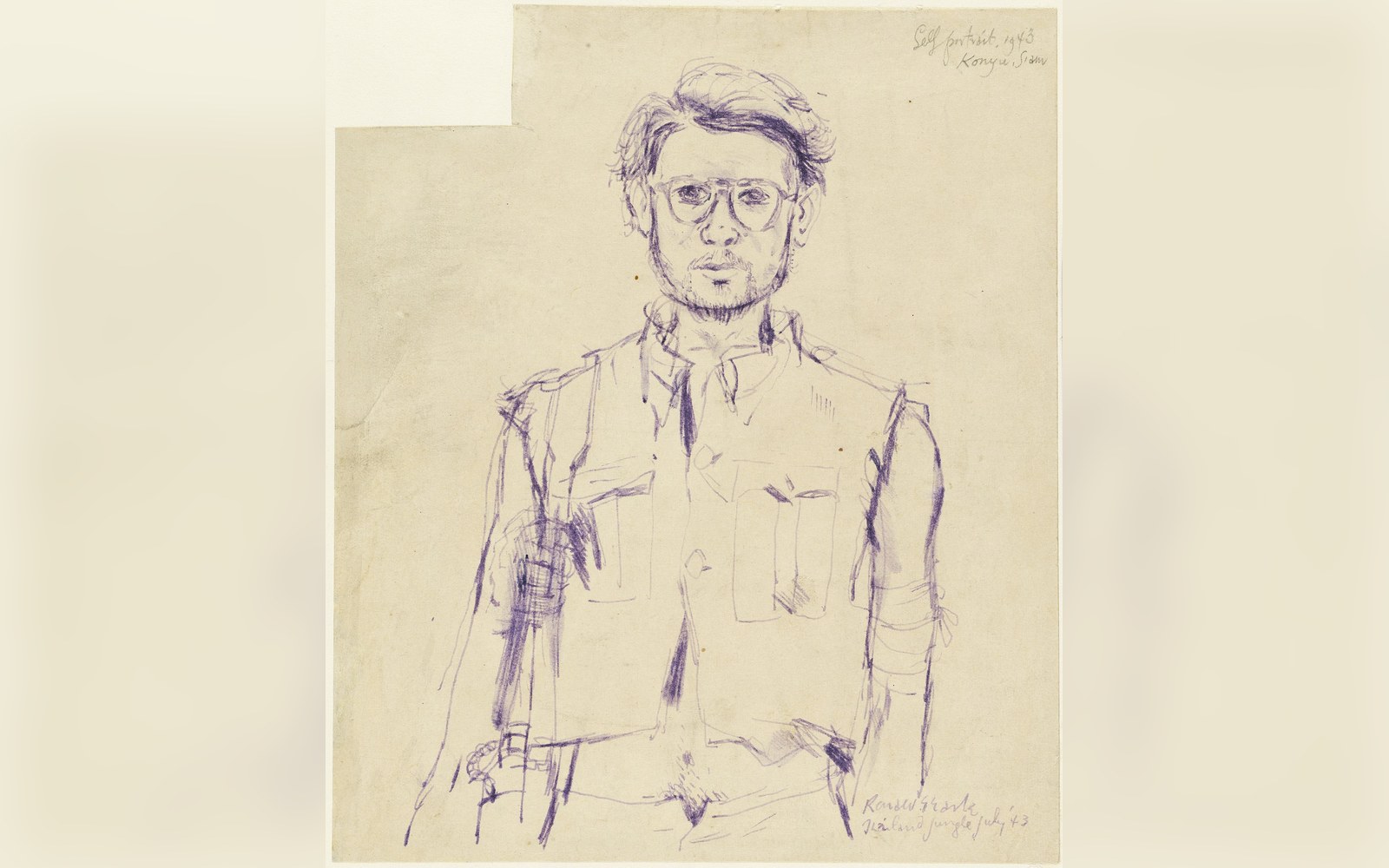
Ronald Searle was twenty-one when Singapore fell to Japanese forces in February 1942. As a prisoner of war at Changi and later on the Death Railway in Thailand, he drew continuously — and hid the results under the mattresses of men dying of cholera, knowing the guards would not search there.
The method was not incidental. It was the entire archival strategy. Searle understood, even then, that the drawings were evidence, and that evidence needed a hiding place the captors had reason to avoid. Cholera wards were that place. The risk the dying men accepted — that contaminated paper might be handled, that the cache might be found — was the condition under which a visual record of the camps could exist at all.
Method under constraint
- 01Changi and Thailand, 1942–1945 — the camps where the drawings were made
- 02Cholera ward — the hiding place; guards' avoidance of the dying created the only safe archive
- 03Three hundred drawings — approximate number Searle carried out of captivity
- 041946 London exhibition — the drawings' first public showing, almost immediately after liberation
- 05Imperial War Museum — primary holding institution
What the drawings are
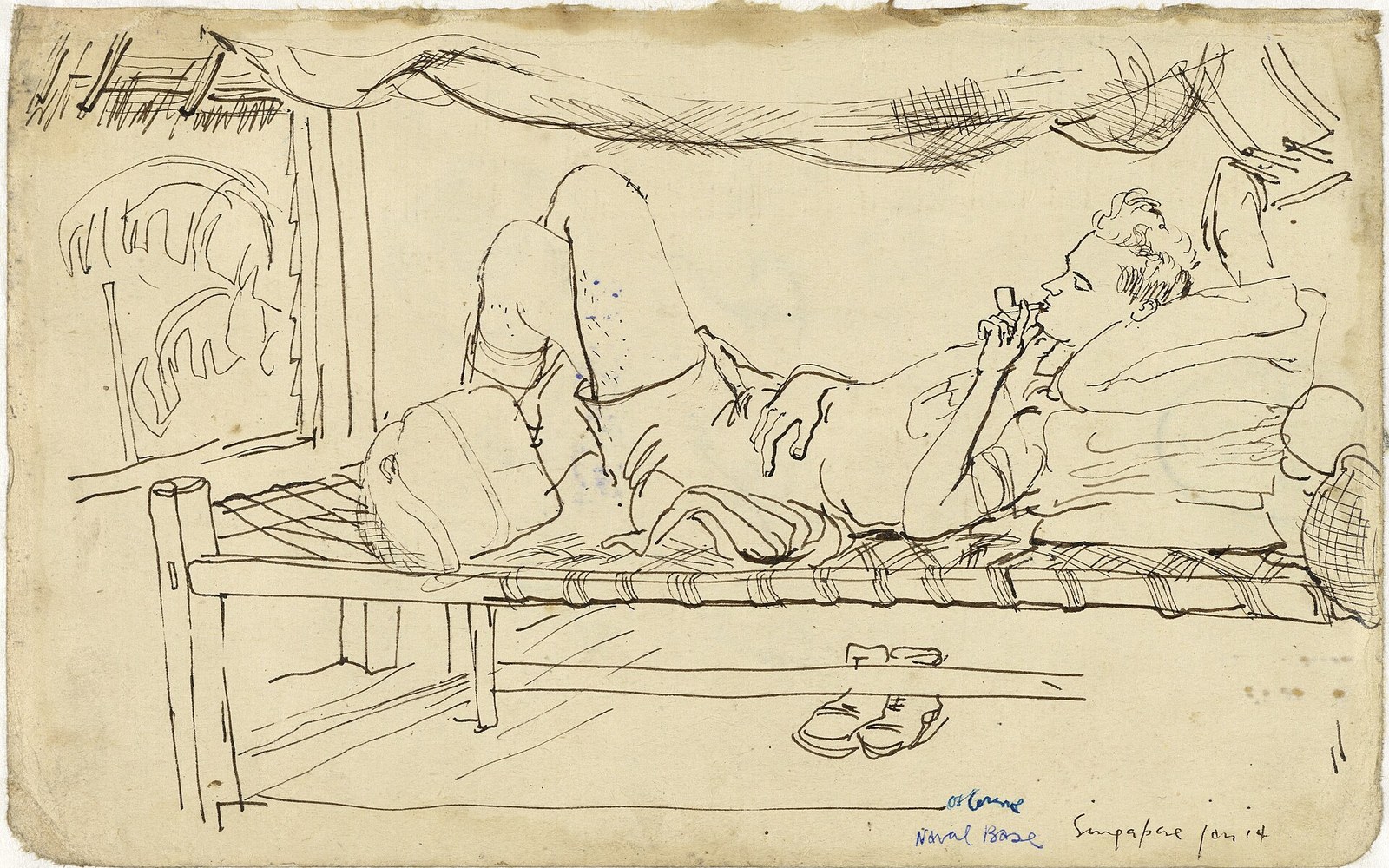
The Changi and Thailand drawings are not protest art. They are witness drawings in the most exact sense: faces of prisoners, working parties, the physical reality of starvation and sickness rendered with a line that is sometimes delicate, often raw, and never sentimental. Searle was trained as a commercial artist in Cambridge before the war, which gave him the drafting economy to work fast on whatever surface he had — paper scraps, the backs of other documents, the margins of things. The materials were whatever captivity allowed, which was almost nothing. Some drawings were made with improvised materials; the ink is sometimes unidentifiable by composition. That material fragility is part of what they are: documents assembled under conditions designed to make documentation impossible.
After liberation in 1945, Searle carried approximately three hundred drawings out of the camps — some of them still on the cholera-ward paper, some stitched into a bundle under his clothing. They were exhibited almost immediately, first in London in 1946, and they were understood at once as something different from press photography or official war art. The line carried a witness quality that reproduction could not flatten. The Imperial War Museum holds the primary collection, and it is where serious study of the sequence begins.
What the method records
The distinction between a photograph and a drawing is nowhere clearer than in work made under prohibition. No camera was permitted at Changi; any that existed were hidden at extreme risk. Searle's drawings record what a camera could not have reached: the sustained, daily texture of captivity rather than its decisive moments. A drawn face takes longer to make than a photograph takes to expose, and that duration is embedded in the mark. You see, in the line quality of the prisoner portraits, both the subject's condition and the speed at which it was necessary to work.
Annotation matters here too. Searle's drawings frequently carry written notes — names, dates, locations — which is how the images remain historically legible rather than generically harrowing. A portrait with a name attached is a record; without it, it becomes a type. The annotated page is the field researcher's standard tool for precisely this reason: the drawing fixes the visual fact, the word fixes its address in the world.
There is also the question of what sustained the practice. Searle drew for the same reason the notebooks stayed hidden: because stopping would have meant conceding that the experience was not worth witnessing. The sketchbook as a form implies a future reader — someone who will open it after the fact — and that implied reader is a form of persistence. Drawing forward, into a future that was not guaranteed, is what all field drawing does at its most serious; Changi makes that normally theoretical point entirely literal.
The cholera-ward archive is the most extreme case of what location drawing asks of its maker: not just observation and economy and fast decision-making, but a judgment about what recording is for and what it costs. Searle survived. The drawings survived with him. The Imperial War Museum holds them under controlled access, the paper condition of many requiring careful handling. They are not comfortable to look at. They are not meant to be.